


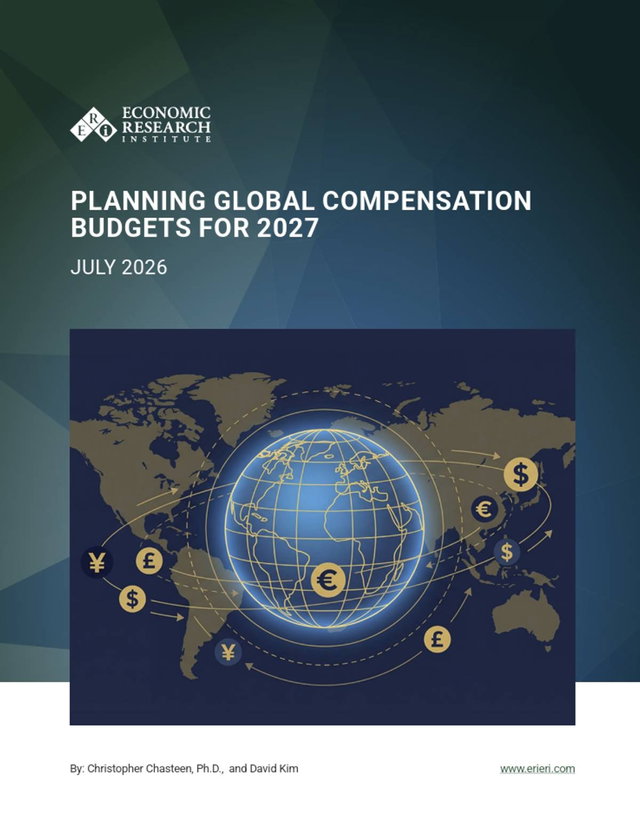
Content Summary
Inside This White Paper
As we enter the next compensation planning cycle, analyzing historical salary trends in conjunction with local economic indicators—such as unemployment rates, gross domestic product (GDP) fluctuations, and inflation—remains essential.
Outlook
The International Monetary Fund has released updated international statistics on unemployment, GDP, and consumer prices for 2025, 2026, and 2027.1 The IMF’s latest World Economic Outlook indicates that the global economy is once again being tested—this time by the outbreak of war in the Middle East and related disruption to commodity markets, inflation expectations, and financial conditions.
GDP
Global GDP growth is projected at 3.1% in 2026 and 3.2% in 2027, following an estimated 3.4% in 2025. At market exchange rate weights, world output is projected to grow 2.6% in both 2026 and 2027. The WEO notes that the 2026 forecast was revised downward by 0.2% relative to the January 2026 WEO update, largely reflecting the disruptions from the Middle East conflict.
Inflation
Global headline inflation is projected to increase from 4.1% in 2025 to 4.4% in 2026 before falling back to 3.7% in 2027. This represents a pause in the disinflation trend and reflects expected increases in energy and food prices. The WEO notes that inflation outcomes remain divergent across countries, shaped by services inflation, tariff pass-through, energy exposure, and country-specific conditions.
Access this content
Choose an option below
Your content has been opened.
Register to access this content
Verify your email to access this content
Code sent. Enter it in the modal
Your content has been opened.
Why do I need to verify I’m human?
Please verify you are a human before opening this content.
Your content has been opened.
The content will open in a new window. You may need to allow popups for this site.
Check your inbox
Global Compensation Trends for 2027 has been emailed to . Entered the wrong email?
Don't see the content in your inbox?
Make sure to check your spam and other messages folders.
Can't get to your email right now?
By accessing content on the SHRM Human Resource Vendor Directory you agree to our Terms of Service and Privacy Policy; and, you acknowledge that your information may be shared with the content publisher.
You might also be interested in
Artificial Intelligence and Compensation Strategies
Discover how organizations are changing their strategies when it comes to artificial intelligence (AI) in compensation. ERI surveyed 187 organizations to identify how artificial...
Read More
Global Minimum Wage Trends for 2026
Inside This White Paper This global minimum wage white paper covers a variety of mid-year 2026 minimum wage updates in the United States, Canada, and other countries that are...
Read More
Guide to Pay Grades and Salary Ranges
Learn how to build and set pay grades and pay ranges that support your organization's compensation strategy. An organization’s pay structure typically will include pay grades and...
Read More









