


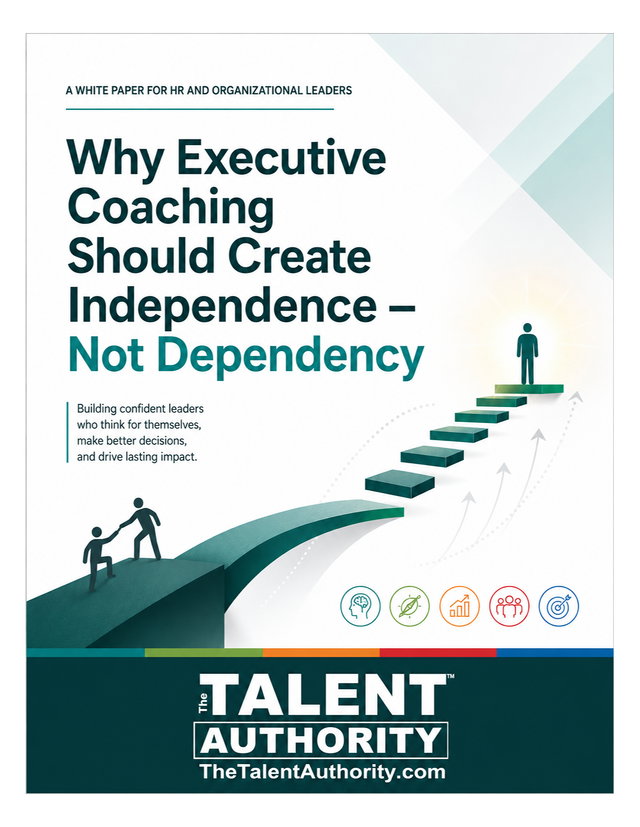
Content Summary
At its best, it helps leaders increase self-awareness, sharpen judgment, improve communication, navigate complexity, strengthen relationships, and make better decisions. It gives leaders space to think, challenge assumptions, and examine the behaviors that may be helping or limiting their effectiveness.
But executive coaching can lose its value when it creates dependency.
If a leader becomes reliant on the coach to interpret every challenge, prepare for every difficult conversation, or validate every major decision, the coaching relationship may feel useful in the moment but fail to build sustainable leadership capability.
That is not the purpose of executive coaching.
The purpose is not to keep the leader dependent on the coach. The purpose is to help the leader become more capable, more self-aware, and more effective when the coach is no longer present. <download the white paper to read the full article.>
Access this content
Choose an option below
Your content has been opened.
Register to access this content
Verify your email to access this content
Code sent. Enter it in the modal
Your content has been opened.
Why do I need to verify I’m human?
Please verify you are a human before opening this content.
Your content has been opened.
The content will open in a new window. You may need to allow popups for this site.
Check your inbox
Why Executive Coaching Should Create Independence – Not Dependency has been emailed to . Entered the wrong email?
Don't see the content in your inbox?
Make sure to check your spam and other messages folders.
Can't get to your email right now?
By accessing content on the SHRM Human Resource Vendor Directory you agree to our Terms of Service and Privacy Policy; and, you acknowledge that your information may be shared with the content publisher.
You might also be interested in
Training, Coaching, or Assessment? How HR Can Decide What a Leader Actually Needs
Training, coaching, and assessment solve different leadership problems. This paper helps HR leaders diagnose whether the real need is skill-building, behavior change, greater...
Read More
California Employment Law Changes for 2027: What Employers Need to Know
California employers face another year of significant employment law changes, including new requirements involving artificial intelligence, leave, retention agreements, pay data...
Read More
From Insight to Impact: The WHO, WHEN, WHAT, WHY, HOW and MEASURE of Leadership Development
Leadership assessment creates insight, but insight alone does not change behavior. A more complete development approach asks six questions: WHO should participate, WHEN should...
Read More









