


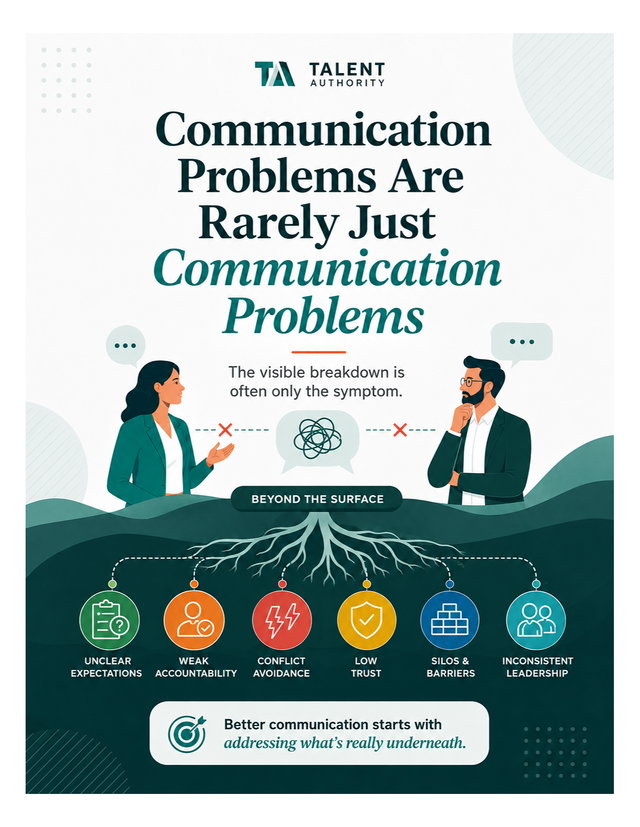
Content Summary
But communication is often only the visible symptom.
Behind the missed message, unclear update, avoided conversation, vague expectation, or frustrated employee is usually something deeper: unclear ownership, inconsistent leadership, low trust, unresolved conflict, poor accountability, competing priorities, or a lack of clarity about what success actually requires.
That is why communication problems can be so persistent. Organizations may respond by encouraging leaders to “communicate more,” send additional updates, hold more meetings, or create new channels. Those actions may help, but they rarely solve the issue if the real problem sits underneath the communication breakdown.
More communication does not automatically create better communication.
In some cases, it only creates more noise.
Communication Breakdowns Often Reveal Leadership Gaps
When employees are confused about expectations, the issue may not be that no one communicated. The issue may be that leaders have not defined priorities clearly enough.
When employees say they did not know a decision had been made, the issue may not be the email they missed. The issue may be that decisions are being made without clear ownership, follow-through, or reinforcement.
<read the full white paper>
Access this content
Choose an option below
Your content has been opened.
Register to access this content
Verify your email to access this content
Code sent. Enter it in the modal
Your content has been opened.
Why do I need to verify I’m human?
Please verify you are a human before opening this content.
Your content has been opened.
The content will open in a new window. You may need to allow popups for this site.
Check your inbox
Communication Problems Are Rarely Just Communication Problems has been emailed to . Entered the wrong email?
Don't see the content in your inbox?
Make sure to check your spam and other messages folders.
Can't get to your email right now?
By accessing content on the SHRM Human Resource Vendor Directory you agree to our Terms of Service and Privacy Policy; and, you acknowledge that your information may be shared with the content publisher.
You might also be interested in
Training, Coaching, or Assessment? How HR Can Decide What a Leader Actually Needs
Training, coaching, and assessment solve different leadership problems. This paper helps HR leaders diagnose whether the real need is skill-building, behavior change, greater...
Read More
California Employment Law Changes for 2027: What Employers Need to Know
California employers face another year of significant employment law changes, including new requirements involving artificial intelligence, leave, retention agreements, pay data...
Read More
From Insight to Impact: The WHO, WHEN, WHAT, WHY, HOW and MEASURE of Leadership Development
Leadership assessment creates insight, but insight alone does not change behavior. A more complete development approach asks six questions: WHO should participate, WHEN should...
Read More








