


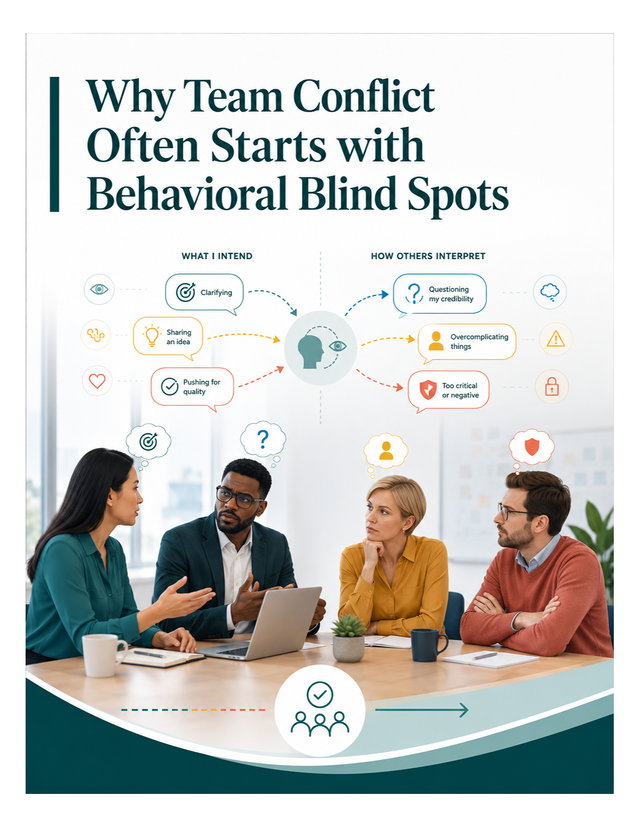
Content Summary
It often begins much earlier — with assumptions.
One person sees a coworker as too blunt. Another sees that same person as direct and efficient.
One person thinks a teammate is moving too slowly. Another sees them as careful and thorough.
One person interprets questions as resistance. Another sees them as responsible risk management.
One person views silence as disengagement. Another views it as reflection.
These interpretations matter because they shape how people respond to one another. Over time, small behavioral differences can become frustration, avoidance, mistrust, side conversations, and conflict.
The issue is not always that people are trying to be difficult.
Often, they are operating from different behavioral styles, priorities, communication preferences, and assumptions about what “good work” looks like.
That is where behavioral blind spots create problems.
<read the full article)
Access this content
Choose an option below
Your content has been opened.
Register to access this content
Verify your email to access this content
Code sent. Enter it in the modal
Your content has been opened.
Why do I need to verify I’m human?
Please verify you are a human before opening this content.
Your content has been opened.
The content will open in a new window. You may need to allow popups for this site.
Check your inbox
Why Team Conflict Often Starts with Behavioral Blind Spots has been emailed to . Entered the wrong email?
Don't see the content in your inbox?
Make sure to check your spam and other messages folders.
Can't get to your email right now?
By accessing content on the SHRM Human Resource Vendor Directory you agree to our Terms of Service and Privacy Policy; and, you acknowledge that your information may be shared with the content publisher.
You might also be interested in
Training, Coaching, or Assessment? How HR Can Decide What a Leader Actually Needs
Training, coaching, and assessment solve different leadership problems. This paper helps HR leaders diagnose whether the real need is skill-building, behavior change, greater...
Read More
California Employment Law Changes for 2027: What Employers Need to Know
California employers face another year of significant employment law changes, including new requirements involving artificial intelligence, leave, retention agreements, pay data...
Read More
From Insight to Impact: The WHO, WHEN, WHAT, WHY, HOW and MEASURE of Leadership Development
Leadership assessment creates insight, but insight alone does not change behavior. A more complete development approach asks six questions: WHO should participate, WHEN should...
Read More








