


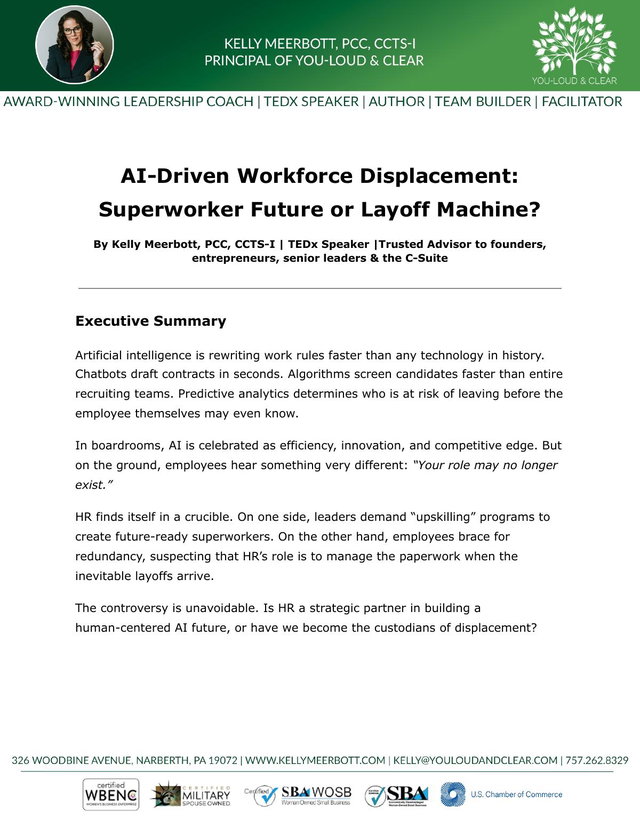
Content Summary
Artificial intelligence is transforming the world of work faster than any technology in history. Executives praise it as a tool for efficiency and innovation, but it feels like an approaching storm for millions of employees. Automation promises a “superworker” future where humans and machines collaborate, yet the reality often looks more like strategic downsizing wrapped in optimistic language.
Goldman Sachs estimates 300 million jobs could be disrupted worldwide, while McKinsey reports that 30 percent of work hours may soon be automated. For HR, this creates an ethical crossroads. Are we building a humane, future-ready workforce, or simply becoming more efficient at managing layoffs?
The paper argues that HR can no longer be a silent observer or the administrative arm of workforce reduction. To reclaim credibility, HR must demand equal investment in reskilling as in automation, embed ethics into AI adoption, and measure success not by cost savings but by the number of people who successfully transition into new roles.
The challenge is both moral and strategic. Will HR be remembered as the conscience that guided organizations through the AI revolution or as the department that handed out pink slips for progress? The answer will define not only the future of work but also the soul of leadership itself.
Access this content
Choose an option below
Your content has been opened.
Register to access this content
Verify your email to access this content
Code sent. Enter it in the modal
Your content has been opened.
Why do I need to verify I’m human?
Please verify you are a human before opening this content.
Your content has been opened.
The content will open in a new window. You may need to allow popups for this site.
Check your inbox
AI-Driven Workforce Displacement_ Superworker Future or Layoff Machine_.pdf. has been emailed to . Entered the wrong email?
Don't see the content in your inbox?
Make sure to check your spam and other messages folders.
Can't get to your email right now?
By accessing content on the SHRM Human Resource Vendor Directory you agree to our Terms of Service and Privacy Policy; and, you acknowledge that your information may be shared with the content publisher.
You might also be interested in

Why Do So Many of Us Start the New Year Exhausted?
Starting the year exhausted? Learn why new year fatigue is so common, how burnout builds, and what real, sustainable care can look like.
Read More
Severance Is a Moment. Job Loss Is a Season.
Most severance packages are built around a single date: the last day. But nobody’s financial life works in single dates. Rent recurs. Groceries recur. The COBRA premium recurs. A...
Read More
Should Your Organization Move to a PEP? A Side-by-Side Comparison with Traditional 401(k)s
Should you move your company retirement plan into a Pooled Employer Plan (PEP), or keep a traditional 401(k)? PEPs were designed to let unrelated employers participate in one...
Read More









